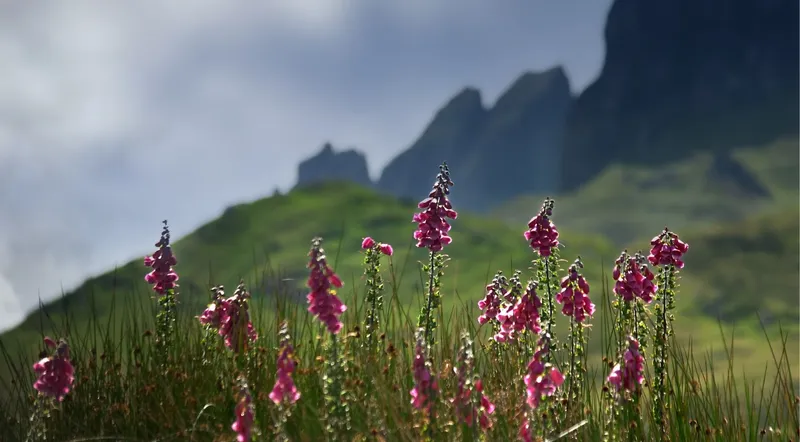
When Should You Go to Skye?
Skye is reachable all year — the Skye Bridge is free and open 24 hours — but many seasonal attractions and boat trips close for the winter. Portree has under seven hours of daylight at midwinter and about 18 hours at midsummer.
Given the choice, May is the best overall month for a first visit. It is Skye’s sunniest — about 196 hours against July’s 134 — among its driest, and the days are long. Midges appear in May, but the main summer peak is still ahead.
June is the strongest alternative if you want the longest days. It is the driest month on the Met Office averages, but it also brings the first major midge emergence.
October and the winter are different trips: autumn colour and the deer rut in October, snow on the Cuillin and very short days later. October brings more than twice May’s rain, and the seasonal closing dates spread from late September to the end of October. For fewer crowds, avoid the school-holiday weeks — the crowding concentrates at the Storr, the Quiraing, the Fairy Pools and Neist Point.
Low cloud can hide the Cuillin in any season, and choosing your dates cannot change that. A clear February day can give you better mountain views than a grey day in June, so if your dates are fixed, spend the clearest day on the Storr or the Quiraing.
- Best overall first visit
- May
- Longest days, driest month
- June — but the first midges arrive
- Lowest midge risk
- November to April
- Main midge season
- May to October, peak in summer
- Boat trips and seasonal attractions
- Mostly April to October
- Puffins
- Mid-May to mid-July, on boat trips
- Autumn atmosphere and the deer rut
- October — much wetter, closures begin
- Best northern-lights season
- October to March — but never certain
- Quieter winter trip
- November to March — short, dark days
- Most useful exact-date checks
- Cloud · wind · rain · boat departures
- 196 hours of sunshine in May, against 134 in July
- 90 mm of rain in May, against 209 mm in January
- 16h 39m of daylight in mid-May
- 14.1 °C average May high
- Met Office long-term averages for the Prabost station on Skye; sun times for Portree.
See What Is Running on Your Dates
The most-booked Skye trip on this site is a three-day loop from Edinburgh, and it runs in every month of the year — which is the practical answer to a short winter day. Live dates and prices below.
Daylight, low cloud over the ridges, wind, midge risk and what is open — for one date. Inside 16 days it reads the forecast; beyond that, the long-term averages. The card says which.
Pick a date to see the daylight, the cloud over the ridges, the wind, the midge risk and what is open.
Without JavaScript this card cannot compute a date. The month-by-month table below carries the same figures for every month of the year.
It reads published seasons, a weather forecast and long-term averages. It does not read live tour availability, road status or midge counts — for those, check Traffic Scotland and CalMac — and seasonal opening dates move by a week or two each year, so confirm anything you are building a day around.
Daylight: the Number Your Itinerary Runs On
Skye sits at 57.4°N, far enough north that the year is lopsided. In mid-December the sun is up for 6 hours 45 minutes at Portree, rising at 08:57 and setting at 15:42. In mid-June it is up for 18 hours 3 minutes, from 04:23 to 22:27. That is a difference of more than eleven hours between the two halves of the year.
It matters more here than the same figure would somewhere compact. Skye is about 50 miles long and its best-known sights sit at the ends of slow single-track peninsulas: the Quiraing, Neist Point, Elgol and Glen Brittle are each an hour or more from Portree, and a drive that looks short on a map routinely takes twice as long. In June you can walk the Storr, drive to the Quiraing and still reach Neist Point for sunset. In December the same plan runs out of light somewhere on the second road.
Skye is not, however, the land of the midnight sun — it is roughly 1,000 km south of the Arctic Circle, and the sun sets every night of the year. What summer takes away instead is darkness, which is the subject of the aurora section below.
The Midge Season, and What Actually Brings Them Out
The Highland midge, Culicoides impunctatus, is the reason a lot of people end up choosing May or September over July. The season runs roughly May to September: males emerge in early May and the females about a week later, and the research that pinned the species down found it dominant right through to September. VisitScotland puts the tail end a month later, at October, while the trapping data behind the Scottish Midge Forecast closes the season in September. Either way, the worst weeks are July and August.
There are two generations a year, six weeks apart. The first peaks in early to mid-June and the second in late July or early August. A dry, hot June thins the second brood out, which is why some Augusts are unexpectedly comfortable and others are not.
The two things that bring them out
Wind. Midges cannot fly in a breeze over about 7 mph — APS Biocontrol, who run the Scottish Midge Forecast, put it exactly there, and the research figure of 3 m/s agrees. Mountaineering Scotland says the same thing in sailor's terms: anything above force 2. A breezy ridge is a midge-free ridge; the sheltered hollow you stop in for lunch is not.
Light, not temperature. The forecast's own operator works from irradiance: below 260 W/m² "the midges come out to play", and below 130 W/m² it is, in their words, "all-you-can-eat buffet time". Bright sun suppresses them. Cloud and fine drizzle switch them on. Heavy rain knocks them back into the vegetation. The widely repeated claim that midges need 10°C is a misreading — that figure belongs to a different group of midges in south-east England, and the people who run the forecast publish no temperature threshold at all.
Activity has two peaks a day, and the dawn one is sharper, running from about 05:00 to 07:00. If you are camping, expect a worse hour at dawn than at dusk.
Clegs — horseflies — run June to September, are concentrated in the northern Highlands and, in Mountaineering Scotland's words, "do not swarm in large numbers and thankfully are relatively uncommon", though the itch can last a fortnight. Ticks are a longer problem: NHS inform gives the season as March to October but advises being aware of them all year, and notes that the Scottish Highlands have a high number of them. Check yourself after any walk through bracken or long grass, and remove one with fine-toothed tweezers, pulling steadily without twisting.
Skye's Weather, and the Month That Surprises People
May is the sunniest month of the year on Skye, not July. The Met Office's Prabost station records about 196 hours of sunshine in May against 134 in July, and the same shape holds at Stornoway and Tiree, so it is a Hebridean pattern, not one station's quirk. May is also among the driest months, at 90 mm, and June is the driest of all at 82 mm — against 209 mm in January.
One thing to understand about those figures before comparing them: a month's rainfall is a total depth across a whole month, not a daily rate, and it says nothing about how many days were wet. Ninety millimetres in May does not mean a wet May — it means that if none of it drained away it would sit ninety millimetres deep by the 31st.
The counterweight matters more than the headline: the number of rainy days barely changes at all. At the Lusa station by the Skye Bridge, the driest month still records 14.6 days with a millimetre of rain or more, and the wettest records 21.7. The dry season on Skye is about how much rain falls, not how often — you should expect rain in some part of most days in any month, and pack for it in July as thoroughly as in November.
Temperature is the factor that changes least, and that is unusual for the latitude. The sea keeps the island mild: Lusa's average daily maximum runs from 7.4°C in January to 17.3°C in August, under ten degrees across the whole year, and there is no air frost at all from June to September. Skye is rarely hot and rarely very cold. What it is, reliably, is wet and windy.
On wind, one caution about figures. The Lusa station sits by the bridge in the lee of the hills and averages 8.1 knots across the year — which is not the Skye of Neist Point, the Quiraing or the Trotternish ridge. For an idea of what exposed Hebridean wind looks like, Tiree averages 14.2 knots and Stornoway 11.9 over the same period. No official gale-day count is published for Skye, so this page does not give one.
The Isle of Skye Month by Month
Temperature, rain and sunshine from the Met Office's Prabost station on Skye. Daylight and sun times for Portree, mid-month.
| Month | Avg high | Rain | Sun | Daylight | What it is good for |
|---|---|---|---|---|---|
| January | 6.6 °C | 209 mm | 33 h | 7h 24m | Snow on the Cuillin, dark skies, the fewest visitors of the year |
| February | 7.1 °C | 168 mm | 64 h | 9h 33m | Still dark enough for aurora; light returning fast |
| March | 8.5 °C | 142 mm | 105 h | 11h 49m | Equinox aurora odds; seasonal attractions start reopening |
| April | 11.2 °C | 95 mm | 151 h | 14h 22m | Castles and boats reopen; no midges yet |
| May | 14.1 °C | 90 mm | 196 h | 16h 39m | The best all-round month — sunniest, dry, and ahead of the main midge peak |
| June | 15.7 °C | 82 mm | 151 h | 18h 03m | Driest and longest; the first midge brood peaks |
| July | 16.9 °C | 102 mm | 134 h | 17h 27m | Everything seasonal is running, and the sea is at its warmest — against peak midges and the busiest weeks |
| August | 17.1 °C | 125 mm | 121 h | 15h 22m | Purple heather; second midge brood; school holidays |
| September | 15.1 °C | 150 mm | 102 h | 12h 53m | Rut begins, midges fading, aurora possible from mid-August |
| October | 11.9 °C | 199 mm | 70 h | 10h 28m | Deer rut, bracken colour, dark skies — but much wetter, and the seasonal closures begin |
| November | 8.9 °C | 205 mm | 41 h | 8h 07m | First snow on the tops; very quiet; most seasonal sites shut |
| December | 7.0 °C | 203 mm | 31 h | 6h 45m | Shortest days of the year; storm watching |
What's Open, and When It Closes
Many of Skye’s seasonal attractions and boat trips run from April into October, but the seasons do not line up with each other, and that is the thing to plan around. Dunvegan Castle alone runs three of them: the castle and gardens are open 1 April to 15 October, the seal boat trips only to 30 September and only Monday to Friday, and the loch cruises to 30 September on split morning and evening hours.
Across the island, a mid-October visitor finds the castle open, the seal boats finished, the Skye Museum of Island Life shut, Talisker part-way through its autumn maintenance, the Glenelg ferry about to stop and, in 2026, the Jacobite steam train in its final week. Late October is the cliff edge: the Elgol boats end, and CalMac's Mallaig–Armadale route switched to its winter timetable on 19 October 2026.
- Dunvegan Castle & Gardens — 1 April to 15 October, 10:00–17:30, last entry 17:00.
- Skye Museum of Island Life, Kilmuir — Easter to late September, Monday to Saturday, closed Sundays.
- Armadale Castle — opens for the season in late March. The operator publishes an opening date and hours but no closing date, so check before a late-autumn visit rather than trusting the 31 October you will see quoted elsewhere.
- Talisker Distillery, Carbost — open seven days a week all year, 10:00–17:00 from March to October and 10:00–16:30 from November to February. Closed 25–26 December and 1–2 January, and its annual maintenance ran 11 October to 1 November in 2026.
- Elgol boats to Loch Coruisk — Bella Jane ran 1 April to the end of October in 2026, seven days a week. Misty Isle sails Monday to Saturday with no Sunday service, and, unusually, runs charters through the winter as well.
- Glenelg–Kylerhea turntable ferry — "annually from April until mid-October", seven days a week, 10:00–18:00. The operator deliberately publishes no exact dates.
- Eilean Donan Castle, on the mainland approach — open from 1 February, with the winter closure running 23 December to 31 January.
What is not normal right now
Checked 20 September 2026. Everything above is the normal published season. Three things on Skye are currently not:
- The A87 is being resurfaced at night along its whole Skye length, from Kyle of Lochalsh to Uig, on weeknights between 7pm and 5am until 2 October. Daytime driving is unaffected. On the Harrapool stretch south of Broadford there is no diversion, so BEAR Scotland holds traffic and releases it on the hour; the Armadale junction stays open throughout.
- The Glenelg–Kylerhea turntable ferry is not sailing. The operator’s own site says only that the ferry “is back in service on Wednesday 23rd September” and gives no reason, so take the return date as published and the suspension as our reading of it.
- There is no fuel in Uig — the filling station is temporarily closed, which matters if you are driving north for the Outer Hebrides sailing. Portree and Broadford are the nearest alternatives.
Three more matter if you are booking ahead rather than travelling now. Talisker’s annual maintenance runs 11 October to 1 November, and while the shop and bar stay open seven days a week, some tours will not run. CalMac’s Mallaig to Armadale ferry carries no vehicles from 16 to 18 October and does not sail at all on the 17th, which would strand a car-touring itinerary built around it. And on the mainland approach, the A87 between Invergarry and Bun Loyne closes overnight until 10 November, with a diversion adding about 17 miles.
None of this changes which month is best. It is here because a page that lists published seasons can read as though the seasons are what is happening today, and on Skye they sometimes are not. For your own dates, the live sources are Traffic Scotland for the roads and CalMac’s service status for the ferries. We recheck this section by 1 December 2026; if you are reading it well after that date, treat it as history and go to those two sources.
Nothing staffed on Skye is open 365 days a year. Talisker comes closest and is the best answer to "what is there to do in January". The free half of the island has no season at all: the Skye Bridge, the hills under Scottish access rights, and the car parks at the Old Man of Storr, the Quiraing and the Fairy Pools, which charge the same all year. Winter weather can still shut a road or a car park on the day.
How Busy Does Skye Actually Get?
Be careful with what you read about this, because the loudest version of the story was wrong. In August 2017 a broadcast report said police were warning tourists without reservations to stay away; Police Scotland's own Lochaber and Skye account denied it the same morning — "We are not advising people not to come to Skye and not turning people away at the bridge - we love visitors & just want people to be prepared." What the local sergeant actually said was that summer is busy, accommodation is at a premium, and people should book before travelling.
The honest shape of the problem is not the island. It is four car parks. Skye and Lochalsh's Local Access Forum put it plainly in November 2017: the "huge increase in users numbers at the Fairy Pools, Storr, Quiraing and Neist Point were not matched elsewhere throughout the island" — and on the Coire Riabhach path, a few minutes away from the Storr, there had been no increase at all since the early 2000s. Skye is not full. Four of its footpaths are.
The one series that actually counts people on Skye
Highland Council has run path counters at the Old Man of Storr for fifteen years, and it is the only published visitor series for anywhere on the island. It shows what happened:
| Year | Walkers past the Storr counters |
|---|---|
| 2010 | 33,248 |
| 2015 | 118,354 |
| 2019 | 223,616 |
| 2023 | 274,009 |
| 2024 | 293,000 |
Highland Council path counters. The Council's own caveat: the numbers "will not account for visitors who may only stop at the car parking area, and not access the paths", so the real figure at the site is higher.
That is roughly nine times as many people in fourteen years on one hillside, and NatureScot now records the Storr landslip as being in unfavourable, declining condition, with recreation named among the pressures. For scale, the only island-wide estimate any public body has published is Highland Council's, for 2017: about 660,000 visitors and 1.6 million overnight stays.
What none of this gives you is a quietest month. There is no published monthly visitor count for Skye — not for the Storr, not for the Fairy Pools, not for the island. What is real and dated is the school calendar: Scottish schools break up in late June and go back in mid-August, English and Welsh schools run later into August, and those weeks are when Skye's accommodation and car parks are under most pressure. July and August are the busy months, and the shoulders either side of them are quieter. Beyond that, anyone telling you that one specific month is the quietest is guessing.
One more thing on the horizon, since it touches cost rather than crowds. Highland Council is consulting on a visitor levy of £5 a night for hotels and short-term lets and £2 for campsites and hostels, charged for nine months of the year and not in December, January or February. The consultation closes on 30 November 2026 and the decision is due that December, with an 18-month lead-in after it — so nothing would be charged before about the middle of 2028.
What You'll Actually See, by Season
Wildlife
- Minke whales — April to October around the Hebrides, according to the Hebridean Whale and Dolphin Trust. Whale and Dolphin Conservation puts the window slightly narrower, May to September, peaking in June and July.
- Basking sharks — May to October (HWDT), or June to October on NatureScot's reading. The Sea of the Hebrides was designated a Marine Protected Area in December 2020 specifically for basking sharks and minke whales.
- Porpoises and dolphins — harbour porpoise, bottlenose and Risso's dolphins are all recorded in every month of the year. Harbour porpoise density here is among the highest in Europe.
- The red deer rut — end of September to November, peaking in the first half of October.
- White-tailed eagles — resident all year, and their nests are protected year-round by law.
- Puffins — mid-May to mid-July is the reliable window; they come ashore from late March or April and most are gone by late July. The published windows spread either side of that — the RSPB gives April to July, the Scottish Wildlife Trust March to August. Skye itself is not where to look for them: isleofskye.com says plainly that puffins are not easy to see around the island, and points visitors to the boat trips.
- Otters — year-round, and here is the detail that changes when you go out: Skye's otters are coastal, and NatureScot says coastal otters are mainly active during the day. The International Otter Survival Fund, based at Broadford on Skye, runs its watching trips from 10am to 4pm for exactly that reason. A calm, flat sea matters more than the hour.
- Seals — the two species pup at opposite ends of the year. Common seals pup in June and July, and their pups can swim almost immediately. Grey seals pup from September to December, and theirs are the white, land-bound ones people photograph.
Colour on the hill
August is the month to promise purple. NatureScot calls the August purple of the heather moors "Scotland's most famous vascular plant show", and while the three heather species flower across a longer spread, ling — the famous one — is at its best in August.
Bracken turns from September. The chlorophyll withdraws as the days shorten, and the fronds go yellow and then reddish-brown, often standing through the winter. A mid-October peak is quoted widely and no Scottish authority publishes it, so this page says September onwards and stops there.
Snow is normally confined to November to April in the Met Office's Northern Scotland region, which includes Skye, with occasional brief falls at height in October and May. One thing to know before a winter walk: the Scottish Avalanche Information Service forecasts for six areas, and the Cuillin is not one of them. Winter walkers on Skye's hills have no avalanche forecast for the hills they are on.
One more thing, because it is repeated often: Skye has no machair. NatureScot's national habitat mapping records 8,902 machair polygons in Scotland and none on Skye. Skye has flower-rich shell-sand beaches and fixed dune grassland — Claigan, Glen Brittle, Camasunary. True machair is in the Outer Hebrides, Tiree and Coll.
The Northern Lights: When They Are Possible at All
The aurora is a bonus, not a reason to pick your dates. It is possible in the darker months and never guaranteed, and on Skye the usual obstacle is cloud, not a quiet sun.
The hard constraint comes first, because it removes a quarter of the year before solar activity is even a question. From about 30 April to 13 August the sky over Portree never reaches astronomical darkness — the sun does not drop far enough below the horizon. Between 24 May and 20 July it never gets darker than nautical twilight at all. On the June solstice, civil twilight ends at 23:37 and starts again at 03:15, and the sky in between stays a deep blue rather than going black.
Real darkness returns to Skye on about 14 August and lasts until the end of April. VisitScotland gives the practical aurora season as October to March, usually between 9pm and 2am, and names Trumpan, Staffin Bay and the Trotternish peninsula as Skye viewpoints. The British Geological Survey's own guidance is that you might expect aurora in the far north of Scotland every few months, looking north from a coast or a hill around local midnight.
Two more things favour the shoulder months. Geomagnetic storms cluster around the equinoxes — the BGS puts it plainly, that there are generally more magnetic storms around March–April and September–October — which is the Russell–McPherron effect, described in 1973 and still the leading explanation. And the sun is on the declining side of its cycle: NOAA's predicted smoothed sunspot number falls from about 92 in December 2026 to 61 by December 2027, against under 20 at solar minimum. That is a quieter sun than 2024's peak but nothing like a dead one, and NASA notes that significant storms are still common in the declining phase.
Two honest caveats. A very strong storm has been photographed from southern Scotland in June, so summer aurora is not flatly impossible — just not worth planning around. And AuroraWatch UK's alerts are real-time, not forecasts: the Lancaster University service tells you the aurora is happening now, and its yellow level means visible by eye from Scotland, amber means likely. For a few days' warning, the BGS publishes a three-day geomagnetic forecast.
Does the Month Change How You Should See Skye?
It changes the arithmetic more than the scenery. In May or June a self-drive day holds three big stops and still finishes in daylight. In November or December the same route does not fit inside the day at all, and the last hour is spent on unlit single-track road with sheep on it.
That is why guided trips are worth more in the dark half of the year than the light half, which is the reverse of what most people assume. Multi-day tours from Edinburgh and full-day trips from Inverness run year-round; island-based departures from Portree are the first thing to stop for the winter. If you are coming in the short months and are not confident about the roads, a guided day buys back the daylight you would otherwise spend navigating.
Our Isle of Skye tours guide compares every starting point, the time-budget guide does the arithmetic on how much fits into three days, and the cost guide puts live prices against eleven real options. For the two months this page rates most highly at either end of the season, see Skye in September and Skye in October.
How We Know, and Where the Evidence Stops
Climate. Temperature, rainfall and sunshine are Met Office 1991–2020 long-term averages for Prabost (station 90), about 10 km north-west of Portree. Rain days of 1 mm or more, air frost days and mean wind are from Lusa (station 19172), by the Skye Bridge, which is the only Skye station publishing them. The two are not mixed within a column: Lusa runs about 0.6°C warmer and 250 mm wetter over the year. The Met Office notes that this series is published for general interest and not for formal climate monitoring, and that where a station has closed, nearby observations help inform the averages.
Sun times are computed for Portree (57.41°N, 6.20°W) and taken from sunrise-sunset.org at mid-month, cross-checked against an independent NOAA implementation. Sources differ by two or three minutes on sunrise and sunset because they define the horizon slightly differently; timeanddate.com gives the June solstice as 18h 00m where sunrise-sunset.org gives 18h 06m. Figures here are the latter, and the darkness dates were verified against Portree's own twilight tables.
Midges. Season and broods from Blackwell and others, Bulletin of Entomological Research (1992); the wind and light thresholds from APS Biocontrol, who run the Scottish Midge Forecast, corroborated by Sanders and others, Journal of Applied Ecology (2011); the dawn-and-dusk pattern from Blackwell, Medical and Veterinary Entomology (1997).
Opening seasons come from each operator's own site, read in September 2026. Most publish a season without a year label and several publish no closing date at all, which is why this page names what is published, tells you to confirm, and does not print dates it cannot support. No 2027 season had been published by any Skye attraction when this page was written, apart from CalMac's note that its summer timetable begins 26 March 2027.
What these numbers cannot tell you. A monthly average cannot tell you what your week will be like: Skye's day-to-day spread is wider than the gap between most of its months, which is why the date checker exists. The climate series is two stations on a 50-mile island with mountains in the middle, so Prabost and Lusa cannot speak for Glen Brittle or the Trotternish ridge. And the opening seasons below are last year's, because next year's are not published yet.
What we could not source at all. No official gale-day figure exists for Skye, so none is given. No Met Office station on or near the Cuillin publishes snow-lying data, so the Ben Nevis snow-cover figure is not transferred to hills 350 m lower. No Scottish authority publishes a peak autumn-colour date. And the frequently quoted claim that a tick must be attached for 24 hours to transmit infection is not on any NHS inform, Public Health Scotland or UKHSA page, so this page gives no hour figure.
Best Time to Visit Skye: Common Questions
What is the best month to visit the Isle of Skye?
May, for a first visit with flexible dates. It is the sunniest month of the year on Skye — about 196 hours against July's 134 — one of the driest at 90 mm, and the days are already close to 17 hours long. Midges start appearing in May, but you are usually ahead of the main summer peak. June is the strongest alternative if you want the longest days: it has the least rain of any month, though it is also when the first major midge emergence normally arrives. October suits autumn colour, the deer rut and dark skies, but expect more than twice May's rain and the seasonal boats and castles closing through the month.
Are there midges on the Isle of Skye, and when?
Yes, from roughly May to September, worst in July and August. There are two generations a year, six weeks apart: the first peaks in early to mid-June and the second in late July or early August. Two things govern whether they actually bite. They cannot fly in a breeze over about 7 mph, and they are brought out by dull light rather than warmth — below 260 W/m² of irradiance, in the words of the people who run the Scottish Midge Forecast. Bright sun suppresses them, cloud and drizzle switch them on. Activity peaks at dawn and dusk, and the dawn peak, around 05:00 to 07:00, is the sharper of the two.
How many hours of daylight does the Isle of Skye get?
At Portree, 6 hours 45 minutes in mid-December and 18 hours 3 minutes in mid-June. Mid-month figures run 7h 24m in January, 11h 49m in March, 16h 39m in May, 15h 22m in August, 10h 28m in October and 8h 07m in November. Skye is about 1,000 km south of the Arctic Circle, so there is no midnight sun and the sun sets every night of the year.
Can you see the northern lights from the Isle of Skye?
Yes, but not in summer. From about 30 April to 13 August the sky over Portree never reaches astronomical darkness, so the aurora is effectively off the table however active the sun is. Real darkness returns around 14 August and lasts to the end of April, and VisitScotland gives the practical season as October to March, usually between 9pm and 2am, naming Trumpan, Staffin Bay and the Trotternish peninsula as viewpoints. Geomagnetic storms cluster around the equinoxes, so late September and March are statistically favourable. Use AuroraWatch UK for real-time alerts, and note they are alerts rather than forecasts.
What is the weather like on the Isle of Skye?
Mild, wet and windy, with a remarkably small temperature range for the latitude. Average daily maximums run from about 6.6°C in January to 17.1°C in August, and there is no air frost from June to September. Rainfall is heavily seasonal in volume — 82 mm in June against 209 mm in January — but barely seasonal in frequency: the driest month still records about 15 days with a millimetre of rain or more, the wettest about 22. Expect rain in part of most days whenever you come.
Is May or September better for the Isle of Skye?
May, on the figures, unless you specifically want autumn. May gets about 196 hours of sunshine and 90 mm of rain; September gets 102 hours and 150 mm, and nearly four hours less daylight. What September offers instead is the start of the red deer rut, a sea that is at its warmest, the midges fading out and dark enough skies for the aurora, which May does not have. Choose May for the weather and the light, September for the wildlife and the atmosphere.
Is the Isle of Skye worth visiting in winter?
Yes, for a different trip rather than a reduced version of the summer one. You get snow on the Cuillin, genuinely dark skies, storm light on the coast and very few people. You give up daylight — under seven hours in December — and most seasonal attractions, boats and island-based tours. Talisker Distillery is open seven days a week all year, and the main viewpoints and their car parks have no closed season, though winter weather can shut a road on the day. If you are not confident driving single-track roads in the dark, this is the half of the year when a guided trip is worth most.
Does it snow on the Isle of Skye?
On the tops, regularly; at sea level, not often and not for long. The Met Office's Northern Scotland guidance puts snowfall normally within November to April, with brief falls at height in October and May, and says snow rarely lies at lower levels outside that window. The Cuillin hold snow far longer than the coast. One safety point that almost no Skye guide makes: the Scottish Avalanche Information Service forecasts for six mountain areas and the Cuillin is not among them, so winter walkers there have no avalanche forecast for their own hills.
What is the worst time to visit the Isle of Skye?
There is no month that does not work, but two are hardest to get value from. Late December and early January give you under seven hours of daylight, the wettest weather of the year and almost everything seasonal closed. And if midges are what you are worried about, late July into August is the peak of the second brood, and it overlaps the Scottish, English and Welsh school holidays. Neither is a reason not to come — they are reasons to plan a different kind of day.