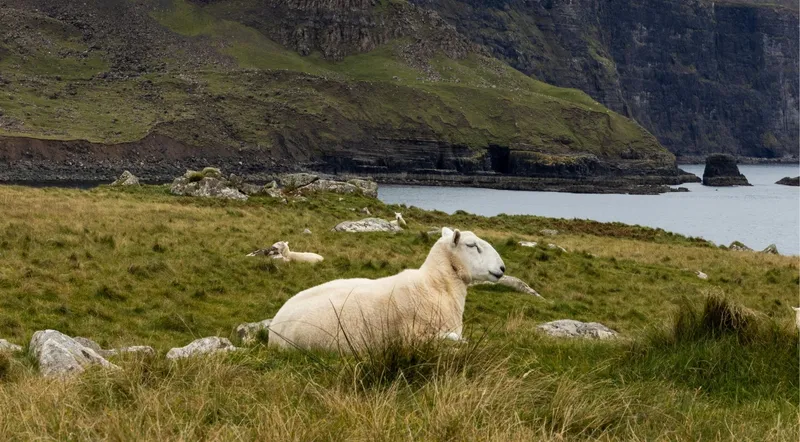
Most people planning a Scottish trip worry about two things: the weather and the midges. September is the month where those two anxieties pull in opposite directions. The midges collapse — they're a minor nuisance by the first week and effectively finished by mid-month — while the weather grows steadily less reliable as Atlantic depressions line up for autumn. In between sits the month's best-kept secret: as the midges clock off, the aurora clocks on, because for the first time since spring Skye's nights get genuinely dark again.
Why September Isn't One Single Season on Skye
Most "best time to visit" guides treat a month as a single block. On Skye in September that's genuinely misleading, because the variable that changes fastest isn't temperature — it's daylight. On 1 September the sun rises over Portree at 06:24 and sets at 20:25, giving almost exactly 14 hours of usable light. By 30 September that's down to about 11 hours 39 minutes. The month sheds roughly 2 hours 20 minutes of daylight from start to finish — the steepest change of any month you'd realistically visit in, and enough to remove a whole viewpoint stop from a day's driving.
Everything else follows from that. Darker nights mean the Northern Lights become possible again. Cooler, windier, wetter conditions finish off the midges. Shorter days and rougher seas mean more boat cancellations. The red deer rut is triggered by shortening daylight, so it starts in the final third of the month. Early September and late September are, in a real sense, two different trips to the same island.
Is September Actually a Good Time to Visit Skye?
Yes — and for hillwalkers and photographers it's arguably the best month of the year. But it's a shoulder-season month with genuine trade-offs, not a free upgrade on summer. Here's the honest three-line verdict before the detail:
- September is a very good alternative to peak season. Midges are sharply reduced, crowds thin out once the English school holidays end in the first week, accommodation drops below August prices, autumn colour arrives and the aurora season reopens.
- Early September still feels like late summer — mild temperatures, summer transport timetables, all attractions running, some midges left in still spots. Late September brings much shorter days, higher storm risk, the deer rut, aurora nights, and seasonal services beginning to wind down toward their October closures.
- It's the wrong month for families tied to school holidays, for wild swimmers who want warm water, and for anyone who needs guaranteed long daylight or the lowest possible chance of a weather cancellation.
If you're still deciding whether the island justifies the journey at all, our companion guide on whether the Isle of Skye is worth the trip covers the landscape-versus-friction question separately from the timing question answered here.
Other Experiences You Might Enjoy
September suits a slower, wider Highland loop, because the roads are quieter and the light is better than in high summer. Popular pairings with the Isle of Skye include Eilean Donan Castle on the approach from Kyle of Lochalsh, a Loch Ness cruise from Inverness, the autumn colour in Glencoe, the Glenfinnan Viaduct and its steam-train season, and a Talisker or Torabhaig distillery tour on Skye itself — all still comfortably in season this month. Browse live options below.
The Biggest September Advantage: the Midges Are Disappearing
For a lot of people this is the single fact that decides the trip. The Highland midge season runs from late May through September and peaks in July and August, when a still, damp evening beside a west-coast loch can be genuinely miserable. September is the month the pressure comes off — and it comes off quickly.
By early September, midges are a minor consideration rather than a defining one, and only really assert themselves in warm, still, sheltered spots on the west of the island — glen bottoms, damp ground near water, dusk with no breeze. By mid-September they are largely gone. The reason is mechanical rather than seasonal sentiment: midges can't fly in winds above roughly 7 mph, which is the figure APS Biocontrol use on the Scottish Midge Forecast. Atlantic weather picks up through the month, and that turns against them steadily.
That's why late September (like early May) is often cited as one of the best compromise windows in the Scottish calendar: decent weather odds with minimal midge activity. Practical version: pack repellent if you're arriving in the first week — a still, mild evening can still produce them — and expect not to think about it at all after about the 15th.
Early September vs Late September on Skye
Same island, same month, two noticeably different trips — here's what changes between the first and second halves.
| What changes | Early September (1–15) | Late September (16–30) |
|---|---|---|
| Crowds | Moderate — English school traffic tails off after the first week | Lower — the quietest Skye has been since spring |
| Midges | Declining fast; still possible in still, sheltered spots | Effectively gone |
| Daylight | ~13–14 hours (14h 0m on the 1st) | ~11½–12 hours (11h 39m on the 30th) |
| Attractions | Fully operating on summer hours | Mostly open, but approaching October closing dates |
| Boat trips | More reliable; Dunvegan seal trips running | Higher weather-cancellation risk; seal trips end 30 Sept |
| Autumn colour | Beginning — heather fading, bracken turning | Noticeably better — golden bracken, first real colour |
| Deer rut | Usually not yet | Starting — roaring stags from around the 20th |
| Aurora | Less likely — nights still too light | Genuine possibility on clear, active nights |
| Storm risk | Lower | Rising as Atlantic depressions line up |
| Best for | First-time sightseeing — the best overall balance | Photography and wildlife — atmosphere over convenience |
Short version: early September is better for sightseeing, late September is better for atmosphere. If this is your first visit and you can choose any dates in the month, take roughly the first two weeks — you keep almost all of summer's daylight and infrastructure while losing most of summer's midges and crowds.
How Much Quieter Is Skye in September?
Quieter, but don't oversell the solitude to yourself. Skye's honeypot sites concentrate almost every visitor into a handful of car parks, and on a fine September day those car parks still fill.
The timing of the drop-off is worth understanding, because it explains the early-vs-late split as much as the weather does. Scottish schools go back in mid-August — most Highland pupils returned around 18–19 August 2026, Edinburgh on the 12th — so the Scottish domestic surge is already finished before September starts. English schools return in the first days of September (roughly the 1st–3rd), so a final wave of English family traffic clears after the first week. That's the moment Skye visibly empties.
What that means at the sites themselves:
- Fairy Pools (Glen Brittle) — the car park is run by the Outdoor Access Trust for Scotland and now charges £8 per car (£4 motorbikes, £10 campervans and motorhomes, £20 tour buses), with a maximum vehicle length of 8 metres and around 177 spaces. Note that many 2026 guides still quote the old £6 fee. It still fills on fine days — arrive before 9am or after 4pm.
- Old Man of Storr — Highland Council pay-and-display, £6 for up to 6 hours or £8 for up to 12 since 1 April 2026, with 70 spaces and a height barrier that excludes motorhomes from the main car park. In season it can be full by 10am; in September you have a wider margin, but a 9am arrival is still the safe play.
- Quiraing — £3 for up to 3 hours, £6 for up to 6, charged 8am–8pm, with only about 40 official spaces. This is the tightest car park on the island and the one most worth arriving early for in any month.
- Neist Point — free and unmanaged, large but busy, exposed and with no facilities.
Accommodation follows the same curve. One aggregator tracked average Portree hotel prices falling from roughly the equivalent of NZ$1,036 in August to NZ$750 in September and NZ$399 in October — a clear shoulder-into-autumn decline. Skye's bed stock is small and it still sells out, so book 4–6 months ahead for a September stay (peak summer needs 6–9 months). Boat trips, popular Portree restaurants, distillery tours and hire cars from Inverness, Glasgow or Edinburgh should also be booked in advance, especially for early-September weekends.
What Is September Weather Really Like on Skye?
Mild, wet and changeable — and heading in the wrong direction as the month goes on.
Averages flatter Skye in September. Daytime highs sit around 14–15°C and overnight lows around 9–11°C, which sounds pleasant and, on a good day, is. The number that matters more is the spread: expect roughly 3–4 hours of bright sunshine a day, cloud cover about 59% of the time, and September as the island's most humid month at around 83–89%.
Temperatures also drift down within the month. In Portree, average daily highs fall from about 14.3°C in the first third to 13.1°C in the final third, and average lows from about 10.9°C to 9.6°C. The warmest early-September day averages about 14.7°C, around the 4th; the coolest overnight low, about 9.2°C, arrives around the 30th.
Rainfall is where sources genuinely disagree, and it's more honest to give you the range than a false precision. Estimates for Portree in September run from about 175 mm to 230 mm, falling on somewhere between roughly 13 and 25 days depending on the dataset. The practical translation: plan for rain on about half to two-thirds of days, usually in bands rather than all day. Portree's wettest single day, on average, falls around 21 September.
Wind is the other Skye constant. Expect a moderate breeze strengthening at times, with gusts around 22 mph on ordinary days and considerably more when a depression crosses; the island has historically recorded gusts up to about 128 km/h, typically south-westerlies. Sea temperature sits around 13°C — swimmable in a wetsuit, bracing without one.
| Portree averages | August | September | October |
|---|---|---|---|
| Average high | ~15°C | ~14–15°C | ~12°C |
| Average low | ~12°C | ~9–11°C | ~8°C |
| Rainfall | ~151 mm | ~175–230 mm | ~152–200+ mm (wettest month) |
| Sea temperature | ~14°C | ~13°C | ~12°C |
| Daylight (mid-month) | ~14.5 h | ~12–13 h | ~11 h |
The trend that matters: October is generally cited as Skye's wettest month, which places September on the rising edge of the wet season rather than the tail of summer. That's the real reason late September carries more disruption risk than early September — not temperature, but the frequency of Atlantic systems.
Is September Good for Hiking on Skye?
This is September's strongest claim. It's frequently described as arguably the best month for Scottish hillwalking, and the reasoning is straightforward: good weather windows still occur, temperatures are cool enough to walk comfortably, the crowds have thinned, autumn colour is arriving, and the midges that make a summer summit-stop unbearable are gone. Cooler air also means less haze on the long views.
The caveats are equally specific:
- Paths get boggy. Skye's peat holds water, and after a wet spell the approaches to the Quiraing and the Storr turn slick and muddy. Proper waterproof boots matter more in September than in June.
- River crossings can become dangerous. The Fairy Pools walk and several Cuillin approaches cross burns that rise fast after heavy rain. A crossing that was ankle-deep in the morning can be genuinely hazardous by afternoon — turn back rather than commit.
- The Black Cuillin remains serious mountaineering. The ridge needs settled conditions and, for most visitors, a qualified guide. September's shorter days shrink the margin for error on any long day out.
- Wind is the limiting factor on the escarpment. The Quiraing and Storr paths are exposed; a strong south-westerly can make the upper sections unpleasant even in dry weather.
The daylight arithmetic is the thing walkers most often get wrong. In late September you're planning around roughly 11½ hours of light, not the 18 hours June offers — so start earlier than feels necessary, and carry a headtorch from mid-month onward. If you're building an itinerary around walking days, our honest time-budget guide to 3 days on Skye shows how quickly driving eats the daylight you were counting on.
Can You Still Take Boat Trips in September?
Yes — September sits comfortably inside the season for every significant boat operation on and around Skye. The question is not whether they're running, but whether they'll sail on your particular day.
- Loch Coruisk trips from Elgol (Bella Jane and Misty Isle) run April to October, with Misty Isle sailing through to the end of October and Bella Jane also operating some trips between November and March. September is well within season.
- Portree wildlife and sea-eagle cruises operate throughout the month, weather permitting.
- Dunvegan Castle's seal trips run 1 April to 30 September — the single hardest end-of-month deadline on the island, and the main reason a wildlife-focused visitor might choose earlier dates.
- The Glenelg–Kylerhea community ferry, the last manually operated turntable ferry in the world, runs seven days a week from April to mid-October — so all of September, closing shortly afterwards. No booking; weather permitting.
- CalMac's Mallaig–Armadale route runs its summer 2026 timetable from 27 March to 18 October, covering the whole month. One scheduled non-service day falls on 7 September 2026 for maintenance, so check before building a travel day around it.
The Atlantic swell is the real variable. Elgol sailings and Portree cruises can be cancelled at short notice, and that risk climbs noticeably in the second half of the month. Two habits protect the trip: book refundable or flexible tickets, and leave a buffer day rather than scheduling your boat trip for the morning you drive home. If a sailing is cancelled, Dunvegan Castle, a distillery tour and Kilt Rock's roadside viewpoint are the reliable indoor-and-low-level fallbacks.
September Wildlife: the Deer Rut, Seals and Sea Eagles
September is the month Skye's wildlife calendar tilts, and the tilt happens almost exactly at the halfway point.
The red deer rut is the headline. Walkhighlands notes that you'll see the 20th of September — or perhaps the 26th — cited as Latha a' Bhuiridh, the Day of the Roaring, and that the rut generally lasts several weeks between mid-September and November, its timing driven by photoperiod rather than temperature. Roaring stags carry a long way across a quiet glen, and it's one of the genuinely memorable things about a late-September visit. Two practical notes: stalking is active in autumn, so check access under the Scottish Outdoor Access Code before heading onto open hill, and keep a real distance from rutting stags — they are unpredictable and dangerous at close range. Scotland's stag close season doesn't begin until 21 October.
Seals pull in the other direction. Dunvegan Castle's seal-colony boat trips finish on 30 September, so the reliable, bookable seal experience belongs to the first half of the month if you want the widest choice of sailing dates and the best weather odds.
White-tailed sea eagles remain visible around Portree and the Sound of Raasay throughout the month, and the Portree wildlife cruises are the easiest way to see them without a long walk.
The landscape shifts too. Heather peaks in August and fades through September; bracken turns golden-brown; and real autumn colour builds from the last week of September into October. That progression is another reason the second half of the month photographs better than the first.
Can You See the Northern Lights from Skye in September?
From mid-to-late September, yes — and this is the clearest single advantage late September holds over any summer month. Through June and July Skye never gets properly dark, so the aurora is off the table regardless of solar activity. As September's daylight drops from 14 hours toward 11½, real darkness returns and the season reopens.
The timing is better than merely adequate. September and October are a statistically favourable aurora window because of the Russell–McPherron effect, described by geophysicists Christopher Russell and Robert McPherron in 1973: around the equinoxes, the geometry of Earth's magnetic field relative to the solar wind "maximizes the coupling between the solar wind and the Earth's magnetic field," in the words of Dr Ciaran Beggan of the British Geological Survey. The scale of that effect is real — per Space.com citing BGS data, on average a sizable magnetic storm happens on nearly twice as many days in March as in June or July. 2026 also remains on the declining side of solar maximum, so elevated activity continues.
None of which guarantees a sighting. You need three things to line up on the same night: geomagnetic activity, a clear sky, and a dark north-facing spot away from village lights. Skye is a recognised dark-sky location, so the third is the easy one — the north and west coasts and the Trotternish peninsula all work. Treat an aurora as a bonus rather than the reason for the trip, and check a live aurora forecast each evening. Even on a quiet night, September stargazing on Skye is far better than anything summer can offer.
What Starts Closing After September?
September is the last full month when almost everything seasonal is still open — the closures cluster in October.
This is a genuine reason to favour September over October, and a genuine reason for late-September visitors to check dates rather than assume. Only one significant thing actually ends on 30 September; the rest of the wind-down happens over the following six weeks.
- Dunvegan Castle & Gardens — open 1 April to 15 October, daily 10am–5.30pm with last entry at 5pm, then closed for winter. Its seal trips run only to 30 September.
- Armadale Castle, Gardens & Museum of the Isles (Sleat) — opens for the season in late March, 9.30am–5pm. The estate publishes an opening date and no closing date, so check before a late-autumn visit. Worth verifying directly anyway: the estate was listed for sale by the Clan Donald Lands Trust in 2025, so its operating status could change.
- Talisker Distillery (Carbost) — open year-round but on reduced hours in September and October, roughly Monday to Saturday 9.30am–5pm with the last tour about 4pm. Its annual maintenance shutdown runs 11 October to 1 November 2026 and may affect tours and experiences, though retail stays open. Book ahead either way.
- Skye Museum of Island Life (Kilmuir) — open from Easter to late September, Monday to Saturday, closed Sundays, then shut for winter.
- Glenelg–Kylerhea ferry — April to mid-October only.
- CalMac Mallaig–Armadale — summer 2026 timetable ends 18 October.
- Buses — Scottish Citylink's 915/916 (Glasgow–Skye) and 917 (Uig–Portree–Fort William–Glasgow) run year-round but shift to reduced winter timetables in autumn, and some summer-only daily extensions end in late September. Stagecoach island services also thin out after summer.
- Kilt Rock and Mealt Falls — a roadside viewpoint, open all year with limited facilities. A useful wet-weather or short-daylight stop.
Put plainly: if your only option is October rather than September, you lose the seal trips entirely, you lose Dunvegan from the 15th, Talisker's tours pause from the 11th, and the ferries and buses start contracting. September buys you the full island. What October buys you instead — the peak of the deer rut, copper bracken, the best aurora odds of the autumn and almost nobody at the viewpoints — is covered in our guide to the Isle of Skye in October.
What's On in September 2026
Skye's biggest events are summer events, and it's worth correcting a common misconception before you plan around one: the Skye Half Marathon is in June, the Skye Agricultural Show was on 1 August 2026, the Isle of Skye Highland Games are in August, the Skye Food & Drink Festival is in late June and Skye Live is in May. None of them fall in September.
What September does have:
- Hebridean Whisky Festival, 5–12 September 2026. The clearest significant September event on Skye. It opens at Talisker on 4 September and Torabhaig on 5 September, showcasing eight distilleries — North Uist, Tobermory, Benbecula, Torabhaig, Isle of Harris, Isle of Tiree, Talisker and Isle of Raasay — across tastings, masterclasses, food, live music and ceilidhs. The finale is a ticketed 200-guest event at Isle of Raasay Distillery on Saturday 12 September, 12pm–5pm, releasing "The Hebridean Whisky Cask 2026" bottling.
- SEALL Festival of Small Halls, running September to November 2026 across Skye, Raasay and Lochalsh — small-venue live music in community halls, with September dates listed on seall.co.uk.
On the mainland, and only realistic as a long day trip or an overnight from Skye (3.5–5+ hours each way), the Braemar Royal Highland Gathering falls on Saturday 5 September 2026, 9.30am–5pm at the Princess Royal & Duke of Fife Memorial Park — around 16,000 attendees, normally with the Royal Family present — and the Pitlochry Highland Games on 12 September 2026. Confirm on each event's own website before committing.
What to Pack for Skye in September
September packing is less about warmth than about staying dry and having light. The non-negotiables:
- Waterproof jacket and over-trousers. Not a shower-resistant layer — actual waterproofs. Rain arrives sideways here.
- Sturdy waterproof walking boots, because the ground stays wet even between showers.
- Warm mid-layers and a fleece, plus hat and gloves for exposed viewpoints and ridge walks.
- A headtorch — the item most people forget and most need after mid-month, when the light goes early.
- Midge repellent (Smidge or a picaridin-based product) if you're travelling in the first half of the month or plan still evenings by water.
- Quick-dry clothing and a power bank, and a wetsuit if you intend to swim at the Fairy Pools or in the sea.
Who Should Visit Skye in September — and Who Shouldn't
September suits you if you're…
- A photographer. Soft autumn light, dramatic skies, golden bracken, thinner crowds at viewpoints and — from mid-month — the aurora. This is the month Skye photographs best.
- A hillwalker who hates midges and queues. Cool walking temperatures, quieter paths, and the biting season effectively over.
- A wildlife watcher. The deer rut from around the 20th, sea eagles all month, seals until the 30th.
- A couple wanting a quieter, more romantic trip than a July visit can offer, at lower nightly rates.
- A whisky enthusiast, with the Hebridean Whisky Festival in the first fortnight and Talisker still running tours before its October shutdown.
- Budget-conscious — accommodation drops meaningfully below August levels.
Choose another month if you…
- Are tied to school holidays. The whole point of September on Skye is that the school traffic has gone.
- Want to swim in comfortable water. A 13°C sea and mountain-fed pools are bracing at best; earlier summer is kinder.
- Need long daylight. If you want 16+ hours to fit everything in, go in June instead.
- Need maximum opening hours and the lowest cancellation risk. July and August are the safest months for that, even with the crowds and the midges. No month on Skye guarantees settled weather.
The Best-Reviewed Skye Day Trip for Shorter September Days
When daylight is dropping by five minutes a day, handing the driving to someone who knows the single-track roads buys back real sightseeing time — with live dates below.
Inverness: Isle of Skye and Eilean Donan Castle Day Trip
Why we recommend it in September: the most-reviewed Skye tour in our entire research set, and a good fit for a month where the daylight window keeps shrinking — Eilean Donan Castle, lunch in Portree and photo stops at Sligachan, the Old Man of Storr and Kilt Rock, all timed by a driver-guide rather than by you and a map.
Free 24-hour cancellation matters more this month than in July: if an Atlantic system parks over the west coast on your chosen day, you can move it. For a slower trip that reaches the aurora and rut window in the north of the island, a 3-day Skye and Highlands tour from Edinburgh (from $242) gives you two nights on or near the island instead of one long day — see our 3-day itineraries guide for how those days are shaped.
Free 24-hour cancellation · reserve now, pay later
Verdict: Which Part of September Would We Choose?
If this were a first visit to Skye and any dates in September were available, we'd book roughly the first two weeks. That window is the month's best overall balance: about 13–14 hours of daylight, summer transport timetables still running, every attraction and the Dunvegan seal trips open, the lowest storm risk of the month — and, crucially, the midges already collapsing. You give up very little of summer and shed most of what makes summer annoying.
We'd choose the last ten days instead for a second visit, or for a trip built around photography and wildlife. Late September is quieter, darker and more atmospheric: roaring stags, golden bracken, genuine autumn light and a real chance of the Northern Lights. The price is about two and a half fewer hours of daylight per day, a higher chance of a cancelled boat trip, and the seal trips gone from the 30th.
Framed the way it's most useful: early September is better for sightseeing, late September is better for atmosphere. Neither half is a compromise — they're different trips, and the one you want depends on whether you're trying to see Skye or to feel it. Whichever you pick, book accommodation four to six months out, choose refundable boat trips, and leave one buffer day for the weather.
Still weighing up whether September is your month at all? Our guide to the best time to visit Skye puts all twelve months side by side on Met Office figures — September gets about 102 hours of sunshine against May’s 196. For the rest of the planning, see our guides to whether 3 days is enough for Skye and what Isle of Skye tours actually cost, or browse the full Isle of Skye tours guide for options from every starting city.
Isle of Skye in September: Common Questions
Is September a good time to visit the Isle of Skye?
Yes — it's one of the best months for hikers and photographers, and a strong all-round alternative to peak season. Midges decline sharply and are largely gone by mid-month, crowds thin once English schools return in the first week, accommodation costs drop below August levels, and autumn colour and the aurora arrive. The trade-offs are real though: daylight falls from about 14 hours on 1 September to roughly 11h 39m on 30 September, and Atlantic storms become more likely as the month goes on.
Is early or late September better on the Isle of Skye?
Early September is better for sightseeing; late September is better for atmosphere. The first half still behaves like late summer — roughly 13–14 hours of daylight, summer ferry and bus timetables, every seasonal attraction open, Dunvegan's seal trips running and lower storm risk. The second half brings the red deer rut, real autumn colour, dark enough skies for the Northern Lights and almost no midges, but only 11½–12 hours of daylight by month-end and a higher chance of boat cancellations. For a first Skye trip, choose roughly the first two weeks.
Are there still midges on the Isle of Skye in September?
Barely, and they fade fast. The Highland midge season runs from about May to September, and VisitScotland runs it to October and peaks in July and August; by early September midges are a minor consideration except in warm, still, sheltered spots on the west coast, and by mid-September they are largely gone. Midges can't fly in winds above roughly 7 mph, and the autumn winds turn against them steadily through the month. Still pack repellent for a still, mild evening in the first week.
What is the weather like on the Isle of Skye in September?
Mild, wet and variable rather than cold. Daytime highs average about 14–15°C and overnight lows about 9–11°C, with roughly 3–4 hours of bright sunshine a day and cloud cover around 59% of the time. Rainfall estimates vary widely by source — roughly 175–230 mm across the month, falling on somewhere between about 13 and 25 days — so plan for rain on around half to two-thirds of days. Skye is windy year-round and Atlantic depressions become more frequent through the second half of the month.
Can you see the Northern Lights from the Isle of Skye in September?
From mid-to-late September, yes — it's the first month of the season when Skye's nights get genuinely dark again. Summer nights never darken enough for aurora watching, but as September's daylight drops from 14 hours to under 12 the window reopens. September and October are also a statistically favourable aurora period because of the Russell–McPherron effect, the equinox geometry that maximises coupling between the solar wind and Earth's magnetic field. Sightings are never guaranteed — you need a clear sky, a dark north-facing spot and geomagnetic activity on the night.
What closes on the Isle of Skye at the end of September?
September is the last full month when almost everything seasonal is open, and the closures cluster in October. The one true 30 September cut-off is Dunvegan Castle's seal-boat trips, which run 1 April to 30 September. Dunvegan Castle itself closes for winter on 15 October, the Skye Museum of Island Life closes in late September, the Glenelg–Kylerhea turntable ferry runs to mid-October, CalMac's Mallaig–Armadale summer timetable ends 18 October, and Talisker has a maintenance shutdown from 11 October to 1 November 2026. Always confirm dates on the operator's own site before travelling.