Last checked: October 2026. Space weather changes by the hour, so always check live alerts on the night.
You can see the Northern Lights on the Isle of Skye, and it happens more often than most visitors expect. What surprises people is how it usually looks. On a typical Skye night the aurora is a pale glow low over the northern sea, and your phone shows the colour far better than your eyes do. Once or twice a winter, a big geomagnetic storm turns the whole sky green and pink over the Trotternish ridge.
Day tours leave Skye around dusk, so if you're not driving, a multi-day tour is the way to be on the island after dark. Timberbush's Isle of Skye, Highlands & Loch Ness 3-Day Tour in the calendar above spends both nights in Portree. This guide covers when to go, where to stand, how to read the forecasts without getting buried in jargon, and how to photograph the lights. There's no guarantee you'll see them, and anyone who promises otherwise is selling something.
Quick Answer: Can You See the Northern Lights on Skye?
- Yes. Skye sits at roughly 57°N, about the same latitude as southern Norway, with very little light pollution.
- Best months: October to March. September, October and March get a small extra boost around the equinoxes.
- Best time of night: VisitScotland suggests 9pm–2am. Skye's best-known local aurora watcher says activity often peaks around 7pm–11pm (UK winter time).
- What you need: a clear sky, full darkness, little or no moon, and an AuroraWatch UK yellow, amber or red alert.
- Where: anywhere with a dark, open view to the north. Waternish, north Trotternish, Staffin and the Glendale/Neist Point area are the classics.
- What to expect: you'll often see a grey-white arc by eye and a green band on camera. Colour you can see clearly by eye usually needs a strong storm.
When to See the Northern Lights on Skye
Best months
In June and July it never gets fully dark on Skye, so the aurora is effectively off the table. From late August the nights lengthen, and by October to March you have long, properly dark evenings. VisitScotland gives the same October–March window for Scotland as a whole.
Within that window there are two things to weigh:
- Equinox months (September, October, March): geomagnetic activity tends to be stronger around the equinoxes than the solstices, which physicists explain through the Russell–McPherron effect. Roughly, the angle between Earth's magnetic field and the solar wind lets energy in more easily around March and September. You don't need the physics, just the result: an autumn or early-spring trip gets a small statistical bonus.
- Deep winter (November to February): activity isn't any stronger, but you get many more hours of darkness. A storm that arrives at 6pm in December is visible; the same storm in late March might land in daylight. But Skye's winter is wet, and cloud rules out more aurora nights than a quiet Sun does. Our Isle of Skye in December guide has the month's new moon and festive dates.
If you're heading over in November, our Isle of Skye in November guide covers what the rest of the trip looks like.
Best time of night
VisitScotland's rule of thumb is 9pm to 2am. Andy Stables runs the Glendale Skye Auroras Facebook page and has photographed the sky over Glendale almost nightly since 2012. He says most auroral substorms peak between 19:00 and 23:00 UTC, leaning towards about 22:00. UTC is the same as UK time in winter. A steady, quiet glow tends to look strongest nearer local midnight.
In practice, start checking once it's fully dark and don't give up at 10pm.
The moon matters
A bright moon washes out faint aurora in the same way it washes out the Milky Way. Strong displays will still show through moonlight, but on an average night the days either side of the new moon are best. Upcoming new moons:
| New moon | Date |
|---|---|
| November 2026 | Monday 9 November |
| December 2026 | Wednesday 9 December |
| January 2027 | Thursday 7 January |
| February 2027 | Saturday 6 February |
When there is a moon, look before it rises or after it sets.
Will 2026–27 be a good year for the Northern Lights in Scotland?
It should still be a good season, though not quite as good as 2024. NOAA and NASA put the maximum of Solar Cycle 25 in October 2024. In January 2026 the Met Office said the Sun appeared to be in a declining phase, with solar maximum all but confirmed to have taken place in 2024 and 2025.
The good news for aurora hunters is that the declining phase doesn't mean quiet. The Met Office has stressed that its vigilance for severe space weather isn't declining, and that in the past some of the strongest space weather events have happened after solar maximum. In September 2026 it repeated the point: big events can still occur during the decline, and long-lived coronal holes on the Sun keep sending fast solar wind our way.
Recent history backs this up:
- 10–11 May 2024: NOAA's Space Weather Prediction Center confirmed the first extreme (G5) storm since the October 2003 "Halloween" storms, and it put aurora over almost the whole of the UK.
- 11–12 November 2025: a severe (G4) storm. The British Geological Survey reported that local magnetic activity reached G5 storm levels at UK observatories.
- 19–20 January 2026: another G4 storm, which the Met Office said was similar in strength to November's.
Expect fewer big storms than in 2024, but strong nights are still very possible through winter 2026–27. Treat any article that claims a "once-in-a-decade" season as hype.
Other Experiences You Might Enjoy
Guided tours of the Isle of Skye run through the winter from Inverness, Edinburgh and Portree, with daylight stops at the Old Man of Storr, Kilt Rock, the Quiraing, Neist Point and Eilean Donan Castle. Browse live options below.
Best Places to See the Northern Lights on Skye
You don't need a famous viewpoint. You need darkness, a clear northern horizon, and somewhere safe to stand. Andy Stables's advice is blunt: you don't drive to find the aurora, you drive to find clear sky. If your own cottage garden faces north over the sea, that may be the best spot on the island.
If you do head out, these are the reliable choices:
| Spot | Area | Facing | Parking / access | Safety notes |
|---|---|---|---|---|
| Trumpan | Waternish | North-west over the Minch | Car park at the ruined church (official Dark Sky Discovery Site) | Easy, flat. One of the best low-effort spots on Skye |
| Stein Jetty | Waternish | West/north-west over Loch Bay | Small car park (Dark Sky Discovery Site) | Water's edge. Keep back from the slipway in the dark |
| Neist Point (car park area) | Glendale, Duirinish | West and north-west | Car park at road end; long single-track road | Stay at the car park. The lighthouse path has steep steps and unfenced cliffs |
| Glendale / Milovaig | Duirinish | North-west over Loch Pooltiel | Roadside only where legal; no passing places | Quiet crofting area. Respect residents and driveways |
| Shulista road end (Rubha Hunish car park) | North Trotternish | North | Small car park by the red phone box | View from near the car park only. The Hunish headland descent is a steep scramble; never attempt it at night |
| Duntulm / Kilmuir | North Trotternish | North and west | Limited laybys; check signage | Castle ruins sit on crumbling cliffs. Stay well back |
| Staffin Bay / Staffin slipway | East Trotternish | North-east | Parking near the slipway and village | Good open view. Watch for wet, slippery rocks |
| Kilt Rock viewpoint | East Trotternish | North and east | Car park on the A855 | Fenced viewpoint but sheer drop. Better at dusk than in full dark |
| Uig Bay | West Trotternish | North-west over Loch Snizort | Village and pier parking | Some village and ferry-terminal lighting |
| Coral Beach (Claigan) | North of Dunvegan | North-west | Small car park at Claigan, then a 20–30 min walk | Only if you know the path in daylight. Rough ground in the dark |
| Kinloch Forest / Camas na Sgianadin / Kylerhea | Sleat and Broadford area | Varies; often hemmed in by hills | Dark Sky Discovery Sites with parking | Excellent for stars. Less ideal for low northern aurora |
A few notes on the classics
Waternish (Trumpan and Stein). If we had to pick one area, it would be this one. Astronomers quoted by Visit Waternish describe it as one of the darkest places on Skye, without a single street lamp on the whole peninsula. It holds three of Skye's nine Dark Sky Discovery Sites, and Trumpan's car park has open views in every direction and no artificial lighting. It's also mostly flat, so it's one of the safer places to stand around in the dark.
North Trotternish (Shulista, Duntulm, Kilmuir). This is the island's northern tip, with nothing but sea between you and the auroral oval. Rubha Hunish is the island's northernmost point and is often recommended for aurora, but reaching the headland means a steep rocky scramble down a cliff. Do the walk in daylight and watch the sky from near the car park at night.
Staffin and the Quiraing. VisitScotland lists Staffin Bay among its top Skye aurora spots. The Quiraing itself is dramatic, but the road over the pass is steep, twisting, single-track and often icy in winter. Stay down at the bay unless you know the road well.
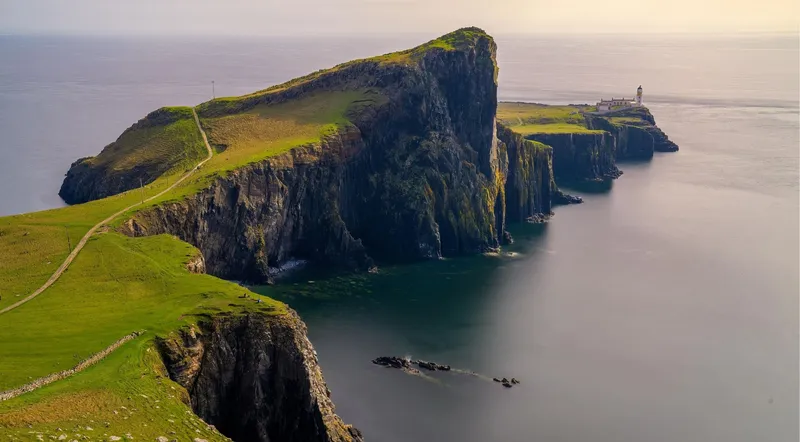
Glendale and Neist Point. This is where many of the best-known Skye aurora photos are taken. The lighthouse view faces west, but the open ground around the car park also has a good north-western sky. Don't walk the cliff paths at night.
Portree and Broadford. You can see strong aurora from the edge of Portree. The harbour and the Scorrybreac path are popular when a display starts, but the town's lights will hide fainter ones. Drive 10–15 minutes out and the difference is obvious.
Sligachan and Elgol. Sligachan is dark but surrounded by the Cuillin, which block much of the northern horizon. Elgol faces south-west towards the Cuillin and is better for stars than for a typical aurora. Try either only during a big storm, when the aurora climbs high enough to clear the hills.
Planning where to base yourself? Our winter bases section compares Portree and Broadford, and what's open on Skye in winter will help you plan meals around late nights.
How to Check the Northern Lights Forecast
The four tools to install
- AuroraWatch UK (Lancaster University). This is the most useful single alert for UK visitors. It's based on magnetometer readings in the UK, so it measures what's happening above Britain instead of giving a global prediction. Alerts come by app, Telegram, X and Facebook.
- Glendale App (aurora-alerts.uk). This is a free web app built by Andy Stables in Glendale on Skye. It sends substorm alerts and is written specifically for Skye aurora hunters. Pair it with his Glendale Skye Auroras Facebook page.
- Met Office space weather forecast. This gives plain-English summaries of expected geomagnetic activity over the next few days, written by the UK's official space weather forecasting centre.
- NOAA SWPC 30-minute aurora forecast (OVATION model). This is a map of the auroral oval looking about 30–90 minutes ahead. If the green band reaches down over northern Scotland, go out and look.
Then check the cloud forecast. The Met Office cloud-cover map and the Clear Outside app (popular with astronomers) are both good choices.
AuroraWatch UK alerts explained
| Alert | What it means | What to do on Skye |
|---|---|---|
| Green | No significant activity | Stay in, unless you're testing the camera |
| Yellow | Minor activity. Aurora may be visible by eye from Scotland | Have a look if it's clear, especially if it stays yellow for a few hours |
| Amber | Aurora likely visible by eye from Scotland | Get your boots on |
| Red | Aurora likely visible by eye and camera anywhere in the UK | Go, now |
AuroraWatch UK's own FAQ adds a useful caveat. A single hour of yellow often comes to nothing, but a sustained yellow, or one that follows amber, is much more promising.
Kp and Bz in plain English
- Kp is a 0–9 global scale of how disturbed Earth's magnetic field is. Online guides commonly say Skye needs around Kp 5 for an aurora you can see by eye, and that cameras pick it up about a level lower. Treat those as rough rules, not thresholds. Kp is a three-hour global average, often forecast days ahead, and plenty of good Skye nights happen at modest Kp.
- Bz is the north–south direction of the magnetic field in the solar wind. When Bz points south (negative) and stays there, energy pours into Earth's magnetic field and aurora builds. A strongly negative Bz lasting half an hour or more is often the first sign a show is coming.
Your night-of checklist
- Late afternoon: check the Met Office space weather forecast and the cloud forecast. Is anything expected, and will it be clear?
- Turn on alerts: AuroraWatch UK and/or the Glendale App on your phone, with sound on.
- After dark: look at the NOAA 30-minute map and the live Bz. Southward Bz plus a yellow or amber alert means get ready.
- Step outside and take a test photo facing north using night mode. A green band on screen means aurora is present, even if the sky looks grey to you.
- Choose the nearest dark, north-facing spot. Don't drive halfway across the island at midnight.
- Stay at least an hour. Substorms come in bursts, and quiet spells between them are normal.
What the Aurora Looks Like from Skye
On most Skye nights the aurora looks like a faint white or grey arch low in the north, easy to mistake for cloud or a distant town. Experienced local watchers will tell you the naked eye never sees an aurora quite like the photos taken the same night. Cameras gather light for many seconds; your eyes can't.
During stronger activity you'll see pillars or rays rising and fading, sometimes moving within seconds. On rare storm nights you get real colour by eye: greens, crimson reds and pinks overhead. Those nights are why people keep coming back.
Give your eyes 15–20 minutes away from screens and torches. Use a red light if you need one.
How to Photograph the Northern Lights on Skye
On a phone
Modern smartphones do this remarkably well.
- Turn on night mode (or astro mode if your phone has it).
- Turn the flash off.
- Set focus to far/infinity if you can.
- Prop the phone on a wall or fence post, or better, use a small tripod and phone clamp. Many phones run a much longer exposure when they detect they're perfectly still.
- Use the 3- or 10-second timer so tapping the screen doesn't shake it.
On a camera
Starting settings for a typical UK aurora:
- Manual mode, manual focus set to infinity (focus on a bright star or distant light, then tape the ring).
- Widest aperture your lens allows (f/1.8–f/4).
- ISO 1600–6400, depending on how clean your sensor is at high ISO.
- 10–30 seconds shutter. Go shorter (5–15s) when the aurora is bright and rays are moving, so the detail stays sharp.
- Auto white balance, RAW files, flash off, lens filters removed.
- A sturdy tripod and the 2s timer.
Put some landscape in the frame for scale, such as a lighthouse, croft house, ruin or sea stack. Practise on a clear night with no aurora so you aren't fumbling with focus when the real thing appears.
Milky Way and stars
Winter isn't the season for the bright core of the Milky Way, which is best in late summer. On moonless winter nights you still get Orion, the Pleiades and a fainter winter band of the Milky Way overhead. Skye's nine Dark Sky Discovery Sites are as good for this as anywhere in Britain: Trumpan, Knockbreck and Stein Jetty in Waternish, Kinloch Forest, Kylerhea and Camas na Sgianadin around Broadford, and three at Clan Donald in Armadale.
Staying Safe on a Night Out
- Cliffs: Neist Point, Kilt Rock, Duntulm and Rubha Hunish all have unfenced drops. Never walk a cliff path for the first time in the dark. Stay within sight of your car.
- Single-track roads: passing places are for passing. Never park in them to watch the sky, even for five minutes. Watch for sheep and deer on the road at night, and read our guide to driving on Skye in winter before you go.
- Ice: clear winter nights are the coldest nights. Roads that were wet at dinner can be black ice by midnight, especially the Quiraing road and the higher A855.
- Cold: standing still at 2°C in a sea breeze is much colder than walking. Bring more layers than you think you need.
- Phone signal: coverage is patchy in Glendale, Waternish and north Trotternish. Tell someone where you're going.
- Respect residents: much of Skye's best dark sky sits above people's crofts. No blocking gates or driveways, and keep headlights and torches off people's windows.
Where to Stay for Dark Skies
The easiest aurora night is the one where you step out of your own front door. When booking, look for a property outside the villages, with an unobstructed view north or north-west over the sea, and ideally no outdoor security lights.
- Waternish, Glendale and Duirinish: the darkest skies and the best north-west views. Browse stays in Waternish and stays in Glendale, where AURORA rural RETREATs is one of the Booking.com listings.
- North Trotternish and Staffin: northern sea views and a quick drive to Kilmuir and Shulista. Browse stays around Staffin.
- Portree: the best winter base for food, fuel and open shops, but you'll need to drive out for dark sky. Browse Portree hotels and guesthouses.
For more detail on bases, see the winter bases section of our what's-open guide.
Northern Lights Tours on Skye
We couldn't find any dedicated nightly Northern Lights tour on Skye this winter, unlike Iceland or Tromsø. Scottish aurora is too sporadic and too dependent on the weather for a scheduled nightly product. What exists is:
- Photography workshops that include night shooting when possible. Examples for 2026–27 include Julian Elliott Photography's Skye & Glencoe tour (23–30 January 2027) and Dean Allan Photography's Skye winter workshops (6–11 December 2026 and 14–19 February 2027). Aurora is a bonus on both, not the focus. Check current prices with each.
- Bespoke local guides such as Lens 57 in Sleat, which offers private photography days and says it may call clients in the middle of the night if conditions look promising.
- Day tours from Inverness and Edinburgh, which leave the island around dusk. Rabbie's Skye and Eilean Donan Castle day trip from Inverness is back in Inverness around 20:00, so any aurora you see is from the minibus window.
- Multi-day tours that stay overnight on Skye, which at least put you on the island after nightfall. Timberbush's Isle of Skye, Highlands & Loch Ness 3-Day Tour and Rabbie's Isle of Skye 3-Day Tour with Accommodation both spend two nights in Portree. Our Isle of Skye winter tours guide compares the rest.
For most people the best "tour" is a hire car, a dark cottage and an alert app.
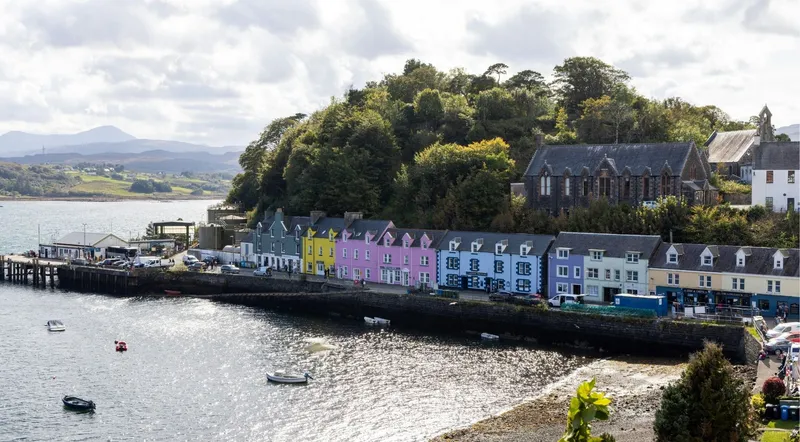
Two evenings in Portree, a short drive from dark sky if an alert comes in. Beds are only included if you select that option, so price them in before you compare.
Check availability
The price includes two nights in small Portree B&Bs, often on the edge of town, which is darker than the harbour front on an alert night.
Check availability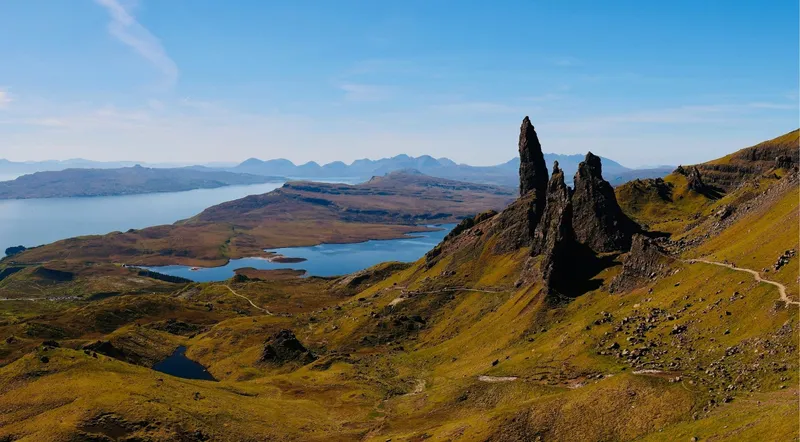
The Storr, Portree and Eilean Donan in a 16-seat minibus. It suits a daytime Skye visit from an Inverness base, not an aurora night.
Check availabilityWhat to Pack for a Night Out
- Warm, windproof outer layer plus a down or synthetic insulated jacket
- Hat, gloves (thin liners that let you use your phone, plus a warm pair), thick socks
- Waterproof boots with good grip
- Head torch with a red-light mode
- Flask of something hot, and snacks
- Fully charged phone and a power bank (cold drains batteries fast)
- Tripod or phone clamp, and spare camera batteries kept in an inside pocket
- A folding chair or sit-mat if you're staying put
The full list for the rest of your trip is in our winter packing list.
Northern Lights on Skye: FAQ
Can you see the Northern Lights on Skye?
Yes. Skye's northern latitude and very dark skies make it one of the better places in the UK. The aurora is photographed from Skye on dozens of nights a year, though fewer nights are bright enough to impress the naked eye.
What is the best month to see the Northern Lights on Skye?
Any month from October to March. September, October and March benefit from the equinox boost in geomagnetic activity. November to February have the longest nights but more cloud. If you're choosing dates, aim for the week around a new moon.
What Kp do you need to see the aurora in Scotland?
As a rough guide, about Kp 5 for a visible aurora on Skye, and less for a camera. Kp is a blunt global average, though. Use AuroraWatch UK's UK-based alerts and the live Bz reading to decide whether to head out.
Where is the best place to see the Northern Lights on Skye?
Anywhere dark with a clear view north. Trumpan in Waternish, Staffin Bay, the Shulista road end in north Trotternish and the Glendale/Neist Point area are the most reliable. Pick whichever is closest to where you're staying.
Can you see the Northern Lights from Portree?
During strong displays, yes, especially from the harbour edges and the Scorrybreac path. Fainter aurora gets lost in the town lights, so drive 10–15 minutes out of town if you can.
Will 2026–27 be a good year for the Northern Lights in Scotland?
Probably a good one, though less spectacular than 2024. Solar Cycle 25 peaked in late 2024 and is now declining. The Met Office notes that strong storms often happen after solar maximum, and both November 2025 and January 2026 brought severe storms.
Can you see the Northern Lights with the naked eye in Scotland?
Yes, but manage your expectations. Most of the time it's a grey-white glow or arc on the northern horizon; the vivid green is what the camera records. Strong storms bring real colour and movement you can see without any help.
The Bottom Line
Skye is a genuinely good place to see the Northern Lights, but the cloud forecast matters far more than the Sun does. Book somewhere dark with a north-facing view, put AuroraWatch UK and the Glendale App on your phone, and check the sky every clear night. If the aurora doesn't show, you'll still have one of the darkest, starriest skies in Britain above you.
Building the rest of your trip? Start with our 3-day Isle of Skye winter itinerary, and warm up after a late night at one of the distilleries in our winter distilleries list.